What oxidation is
UV breaking down the clear coat from the top
Clear coat contains UV absorbers that sacrifice themselves protecting the layers underneath. Under the sustained UV load of a North Texas summer, those absorbers deplete. The polymer at the surface then begins to break down, becoming porous and micro-rough. Light hits that degraded surface and scatters instead of reflecting, which is the chalky, faded look people recognize as oxidation.
It always starts on the horizontal panels — the roof, the hood, the tops of the fenders and the trunk lid — because those take the most direct sun. That is why an oxidized vehicle often has doors that still look reasonable next to a roof that has gone matte. Red and other single-stage colors show it soonest and most dramatically, with the pigment itself chalking to a pale pink that transfers onto a cloth when you wipe it.
Can it be fixed
It depends what is left underneath
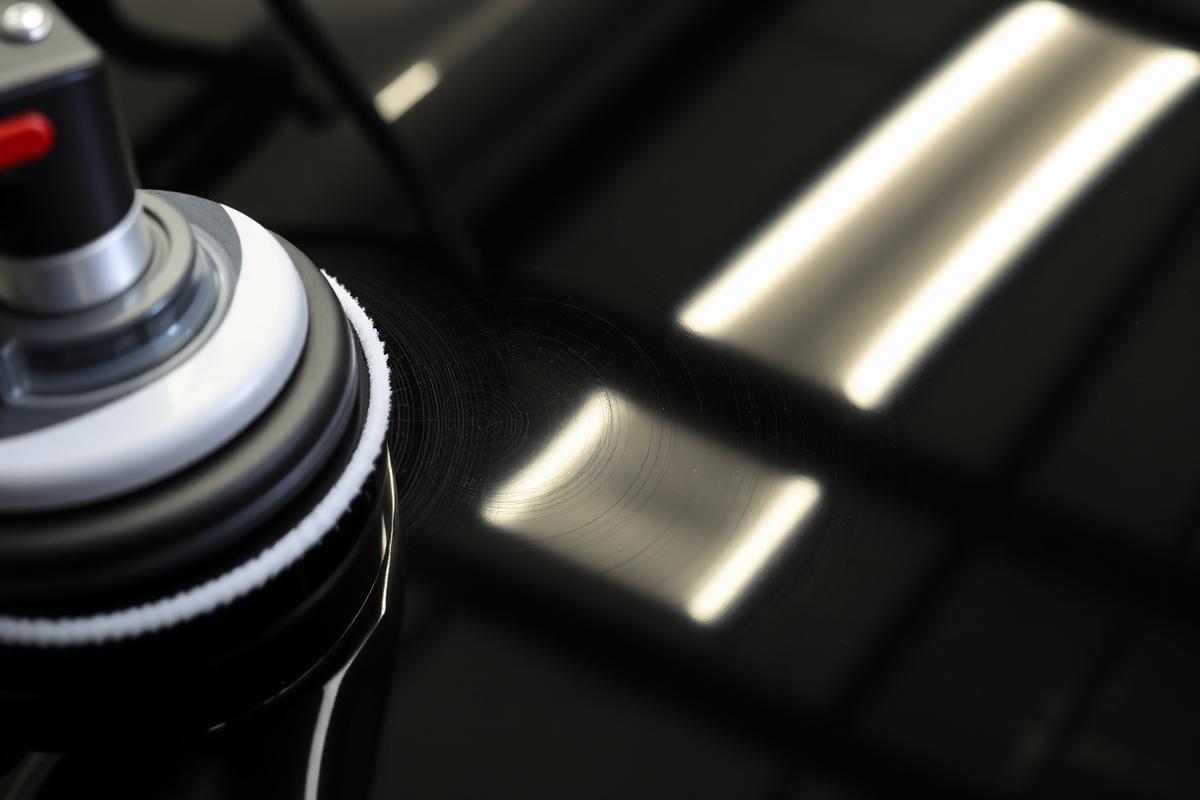
If the oxidation is confined to the top layer of the clear coat and there is enough sound clear coat beneath it, polishing removes the degraded material and exposes intact clear underneath. The gloss returns and the result is often startling — half a hood polished next to the untouched half is the most convincing demonstration in this trade.
If the clear coat has failed completely, the answer is different. Failed clear looks like peeling, flaking or cloudy white patches with defined edges, most often on a roof or hood. That is not oxidation, it is delamination, and polishing cannot fix it — removing more of a layer that has already failed just accelerates it. The only correct answer there is a repaint, and we will tell you that rather than take money for a temporary cosmetic improvement.
Process
Restoration in stages
- 01
Assessment
Determine whether the clear coat is degraded or actually failing, and check thickness where the history is unknown. This decides whether the job goes ahead.
- 02
Decontaminate
Wash, iron removal and clay, because oxidized paint is porous and holds far more embedded contamination than healthy paint.
- 03
Compound
A cutting stage removes the degraded surface layer. Test sections confirm how much is needed before committing across the vehicle.
- 04
Refine and protect
A finishing polish restores clarity, then a sealant or coating goes on — mandatory here, since restored paint with depleted UV absorbers will oxidize again quickly if left bare.
Also affected
The other surfaces the sun ruins
- Headlight lenses gone yellow and hazy, restored separately
- Black plastic trim and mirror caps faded to grey and chalky
- Rubber window and door seals dried out and cracking
- Wheel arch and rocker cladding on trucks and SUVs, which fades badly
- Roof rails and bed rails, which take direct sun all day
- Convertible tops and vinyl surfaces, which lose their color and flexibility
- Interior dash tops, which crack from the same UV coming through the windshield
FAQ
Common questions
Can badly faded red paint be restored?
Often, yes, and single-stage red responds dramatically when there is sound paint beneath the chalked layer. The test is simple: wipe a small area with polish on a cloth. If pigment transfers and the spot brightens, there is material to work with. If the paint is thin or already through in places, we will say so.
How can I tell oxidation from clear coat failure?
Oxidation is uniform dullness across a panel. Failure has defined edges — patches that look cloudy white, with a visible boundary, sometimes peeling at the edge. Failure typically starts on the roof or hood. Polishing helps the first and cannot help the second.
How long will the restored finish last?
That depends entirely on protection and parking. Restored paint has depleted UV absorbers, so bare it will fade again within a season or two in this climate. With a ceramic coating and shade or covered parking where possible, it can hold for years. Protection is not optional on a restored finish.
Is it worth doing on an older vehicle?
Frequently, yes, because the alternative is a repaint costing many times more. A fifteen-year-old truck with faded but sound paint can be transformed. What is not worth doing is polishing a vehicle whose clear coat is already delaminating, and we assess that before quoting.
Do you restore faded plastic trim as well?
Yes, faded black plastic is treated as part of this work. Cleaning and a trim restorer bring back the depth, though the honest note is that trim restoration is not permanent in Texas sun and needs renewing periodically. Dedicated trim coatings last considerably longer than dressings.
Ready to book mobile detailing?
Tell us the vehicle, its current condition and where it will be parked, and we can put together a quote and a time that works.